Trip in
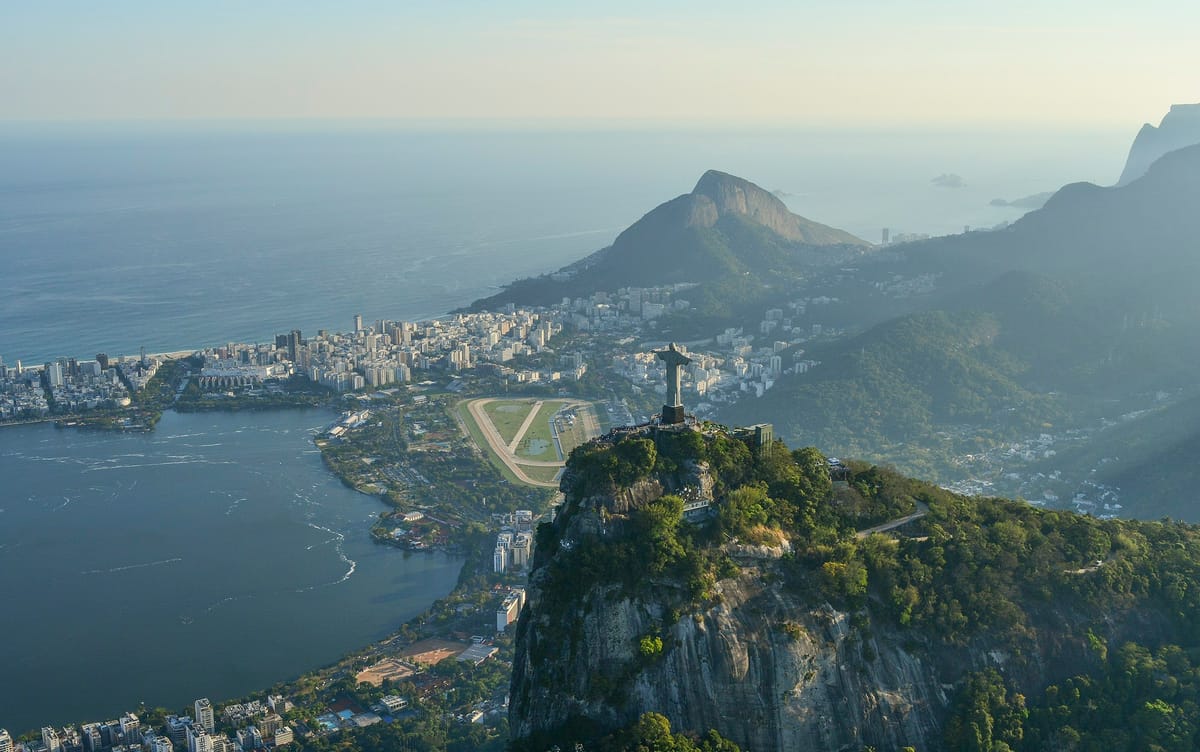
 He stands with his arms thrown open over the city, almost 700 metres above the surf and samba, his head tilted ever so slightly downward as if to bless the whole glorious, chaotic sprawl of Rio de Janeiro. You will see Christ the Redeemer from the plane window, from the beach, from a thousand postcards.
But nothing prepares you for the moment you stand at his feet, the wind tugging at your shirt, the Atlantic glittering one way and the green corridors of the Tijuca forest the other, and you realise the statue is far stranger, older, and more human than you imagined. This is the full visitor's guide, how to get up, when to go, what to look for, and the secret history most travellers never hear. And yes, we will sort out your Christ the Redeemer tickets too.
I have taken hundreds of travellers up Corcovado over the years, in blazing January heat and in the soft gold of a winter morning. The mountain rewards the prepared and punishes the impulsive. So let's do this properly.

Christ the Redeemer tickets: what you actually need to know
Here is the single most important thing I can tell you: book ahead, and book a timed entry. Christ the Redeemer is one of the most visited monuments in the world, and the summit of Corcovado is a small place. Access is controlled, capacity is capped per time slot, and on a sunny weekend in high season the queues for the official transport can swallow your whole morning if you arrive without a reservation.
Your ticket isn't just a pass to the statue, it bundles your ride up the mountain, because you cannot simply drive your own car to the top. Corcovado sits inside Tijuca National Park, and the final ascent is by official authorised vehicle only. When you reserve, you choose your method (the cog train or the official park vans), your departure point, and crucially your time window. Treat that window like a flight: be early, not on-time.
Insider tip
The cheapest-looking ticket is rarely the smartest. The real cost of a visit is time, not money. A slightly pricier slot at the right hour, early morning, midweek, buys you clear photos and breathing room, which is worth far more than a few saved reais at noon in a crush of selfie sticks.
One more thing before we climb: prices, schedules, and which entry points are operating do change, sometimes at short notice for maintenance or weather. I won't quote you a figure that might be wrong tomorrow. If you'd like us to lock in the right slot, check current availability, and pair it with the rest of your day, that's exactly the kind of thing we live for.
Want us to secure your Corcovado time slot and build the perfect Rio morning around it? We're right here in the city.
Plan my trip on WhatsAppHow to get to the top: three very different journeys
There is no single "right" way up Corcovado. There are three, and each tells a different story about Rio. Choose by your appetite for romance, speed, or sweat.
The Corcovado cog railway, the classic
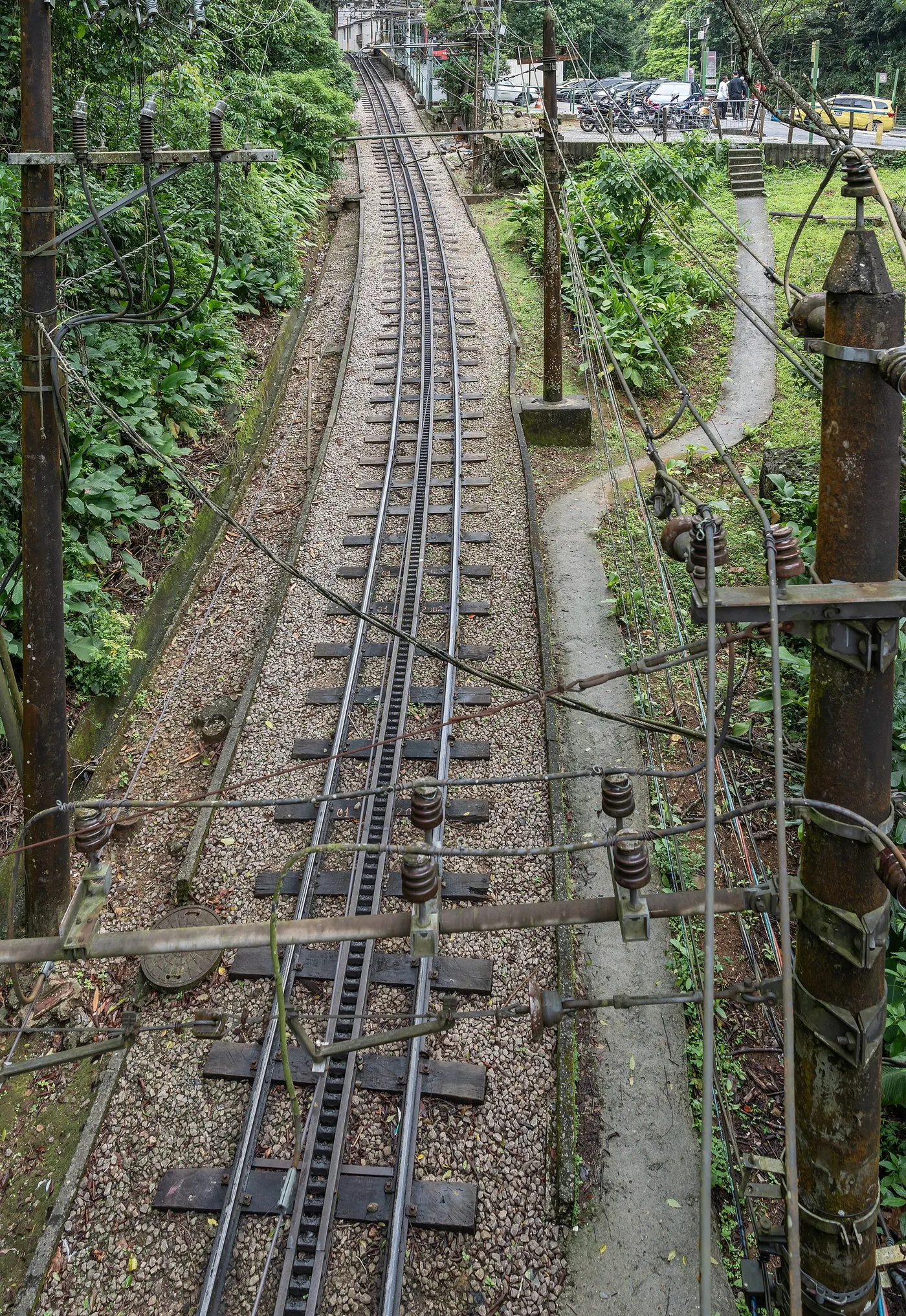
If you do only one thing my way, take the train. The Corcovado rack railway opened in 1884, decades before the statue existed, originally carrying Emperor Dom Pedro II and Rio's well-to-do up to the breezy heights. It is one of the oldest mountain railways in Brazil, and it climbs at an angle that presses you back into your seat as it grinds up through dense Atlantic rainforest.
This is the only ascent where the journey is the attraction. Toucans flit between the trees, sunlight strobes through the canopy, and after about twenty minutes the forest parts and the city detonates into view. Sit on the right-hand side going up for the better glimpses of the bay. The little train station at the bottom, in Cosme Velho, is a charming neighbourhood worth ten minutes of wandering before you board.
Official park vans, fast and flexible
Authorised vans depart from designated points (commonly Paineiras and Largo do Machado, among others) and switchback up the mountain road. They're typically quicker than the train and run more frequently, which makes them handy if you're slotting Christ the Redeemer between other stops. You still pass through Tijuca's greenery, just at speed and on the road rather than the rails. For travellers tight on time or visiting in a tight window, the vans are often the pragmatic choice.
Hiking up via Parque Lage, for the bold
Here is what most visitors never even consider: you can walk to Christ the Redeemer. The trail begins at the gorgeous Parque Lage, an early-20th-century estate with a mansion, a palm-fringed courtyard café, and a fairy-tale grotto, set right against the forest. From there a steep, rooty, sweat-soaked path winds up through Tijuca, one of the world's largest urban forests, for roughly two hours to the summit area.
It is not a stroll. It's a real hike with some scrambling, and I'd never send you up it alone or in the dark. But arriving at Christ on your own two feet, legs burning, having earned that view, is one of the great Rio experiences. Go with a guide, go early, carry water, and you'll feel like you've discovered a secret the tour buses will never know.
Insider tip
Whichever way you ascend, you still need a valid entry to the monument platform itself. Hikers, sort your access in advance, because turning up at the top without it is a heartbreaking way to end a two-hour climb.
Planning the logistics of getting around the city is half the battle, see our wider notes on things to do in Rio and let us help you plan a trip that flows instead of stalls.
The story behind the statue: an idea a century in the making
Most people assume Christ the Redeemer is ancient. It isn't, and the tale of how it got built is far better than the myth.
The dream of a great religious monument on Corcovado dates back to the 1850s, when a Catholic priest, Pedro Maria Boss, suggested placing a Christian statue on the peak to honour Brazil's then-Princess Isabel. The idea went nowhere for decades. It was only revived in earnest in the 1920s, as Brazil approached the centenary of its independence, when the Catholic community in Rio mounted a fundraising campaign, donations from ordinary Brazilians, gathered in churches across the country, to make it real.
Construction ran from 1922 to 1931, and the statue was inaugurated on 12 October 1931. The Brazilian engineer Heitor da Silva Costa designed and led the project; the figure was shaped by the French sculptor Paul Landowski. And here is the detail that gives me chills every single time: the face of Christ was sculpted by the Romanian artist Gheorghe Leonida. That serene, downward gaze that seems to meet your eyes from any angle, that's his work.
It is not an ancient relic. It is a modern marvel, raised by the small donations of a young nation that wanted to crown its city with grace.
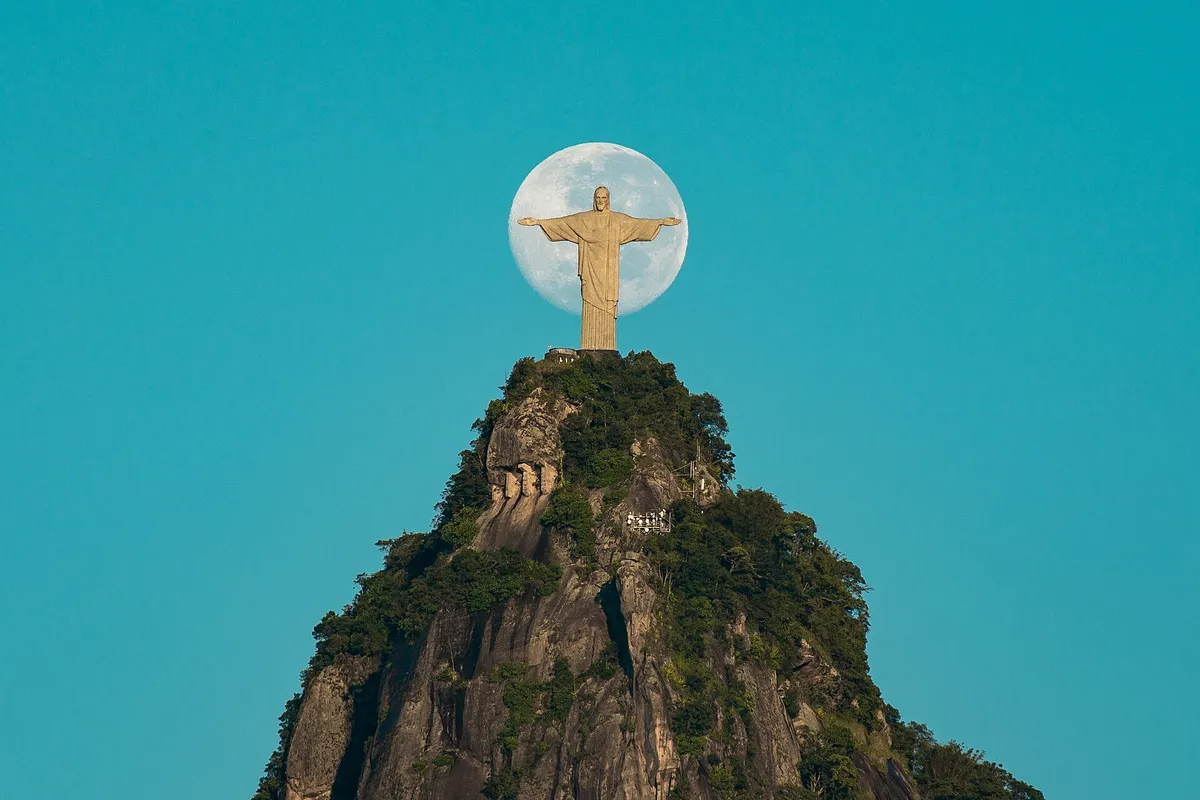
The statue stands roughly 30 metres tall, set on a pedestal of about 8 metres, with an arm span of around 28 metres, arms wide enough to seem to embrace the entire city. It is built of reinforced concrete and clad in a skin of soapstone (pedra-sabão), a soft, pale stone chosen partly for its durability and the way it weathers. The pedestal even contains a small chapel.
Love this kind of detail? Our Rio-based guides weave the real history into every tour, no dull script, just the good stuff.
Plan my trip on WhatsAppA modern wonder of the world
In 2007, Christ the Redeemer was voted one of the New 7 Wonders of the World, in a global poll, one of three of the seven located in the Americas, alongside Peru's Machu Picchu and Mexico's Chichén Itzá, and a moment of enormous pride for Brazil. Standing among the likes of the Great Wall of China and Machu Picchu, Rio's open-armed Christ holds his own as a symbol recognised the world over.
It also has a more turbulent relationship with the heavens than its calm pose suggests. Perched on an exposed summit, the statue is struck by lightning regularly, and has occasionally been damaged and repaired, including to the fingers and head. Restoration teams keep spare soapstone on hand precisely for this reason. There is something poetic about a figure with arms raised to the sky being repeatedly touched by it.
Did you know? The oddities most guides skip
- It's a forest, not a wilderness. The Tijuca rainforest you ride through was largely replanted by hand in the 19th century after the hills were stripped bare for coffee plantations, one of the earliest large-scale reforestation efforts anywhere. The jungle around Christ is a man-made miracle.
- The face follows the engineering, not just the art. Leonida's serene expression was designed to read clearly from far below, where the head tilts down toward visitors and the city.
- There's a chapel inside the base. Few visitors realise you can attend mass, and even weddings have been held, within the pedestal of the statue.
- The materials travelled far. The soapstone cladding was assembled from countless small tiles, and according to tradition some were inscribed with names by the women who helped prepare them.
Best time to go: chasing clear skies and dodging crowds
Corcovado makes its own weather. The summit is so high that it can be wrapped in cloud while the beaches below bake in full sun. There is nothing more deflating than reaching the top to find Christ's head lost in mist and the view replaced by grey soup. Avoid that fate with timing.
The best hour
Go first thing in the morning, ideally on the earliest available slot. The air is clearer, the light is soft and flattering, the temperature is bearable, and the crowds are thinnest. By late morning the platform fills, the haze builds, and midday sun blows out your photos into harsh white. Late afternoon can be magical for golden light, but it's also the most crowded and the most cloud-prone in summer.
The best season
Rio's drier, cooler months, broadly the winter, around May to September, tend to deliver the most reliably clear skies. The humid summer (December to March) brings spectacular heat and energy but also more cloud and sudden downpours over the peaks. For a deeper look, see our guide to the best time to visit Brazil.
Insider tip
Watch the mountain before you commit. From the city you can often see whether Corcovado's summit is clear or capped in cloud. If it's socked in at 9am in summer, it may clear by mid-morning as the sun burns it off, a flexible van slot lets you adapt. If you can see the statue clearly from the street, go now.
What's waiting at the top
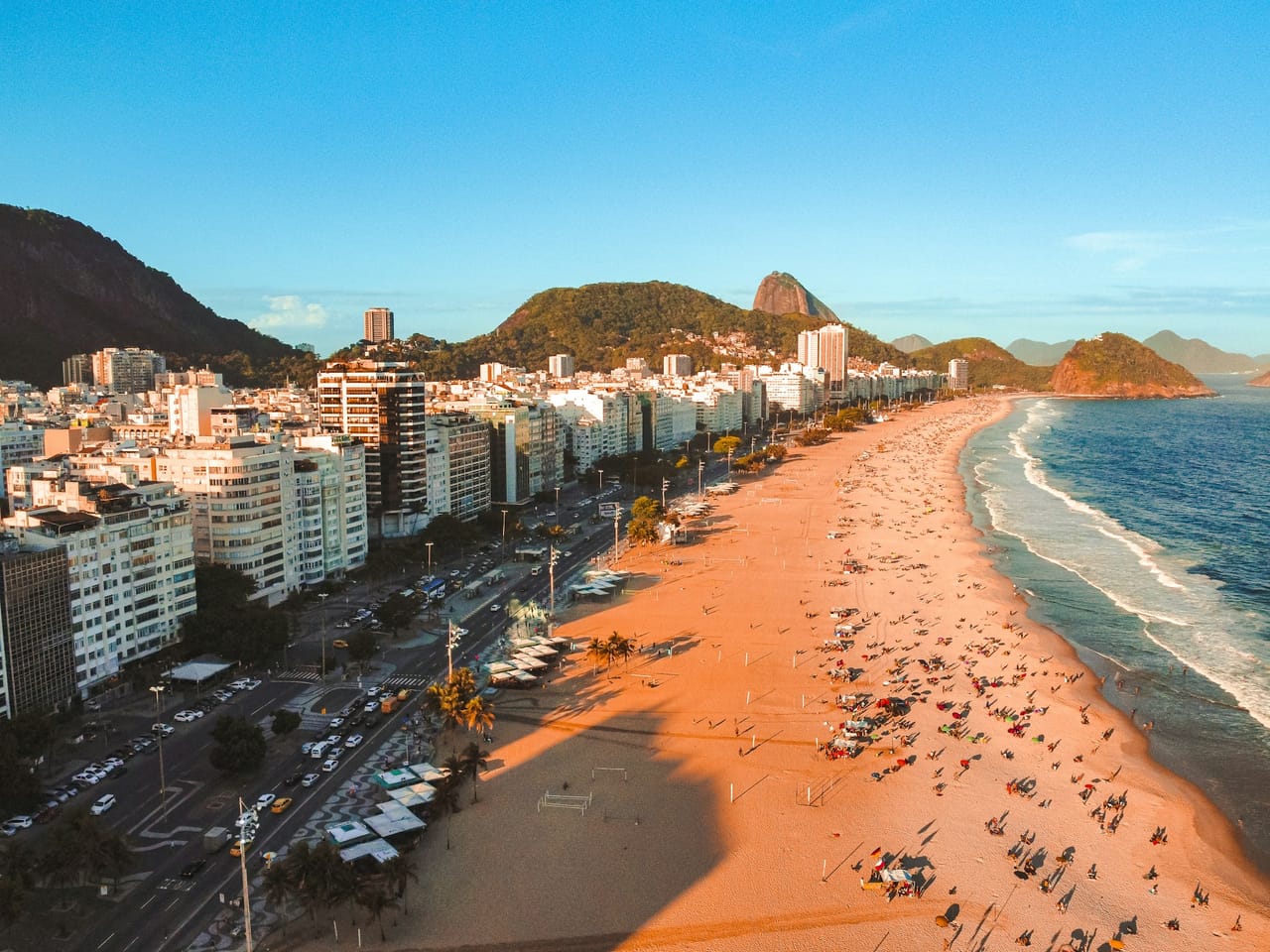
The summit is more than the statue. There are viewing terraces wrapping the base, a small chapel, a café, and a gift shop, all connected by stairs, escalators, and elevators. From the platform, the city unfurls in a 360-degree sweep: Pão de Açúcar (Sugarloaf Mountain) jutting into Guanabara Bay, the great curve of Copacabana and Ipanema, the lagoon, the Maracanã stadium, and the endless green ridges of Tijuca rolling toward the horizon. On a clear day you can trace the entire geography of Rio in a single, slow turn.
Give yourself time. Most people rush the photos and leave. Linger instead, find a quiet corner of the terrace, let a tour group pass, and just watch the light move across the bay.

Photography tips, including the famous lie-down shot
Getting a great photo of Christ the Redeemer is genuinely tricky, because the statue is enormous and you're standing almost beneath it. Here's how to nail it.
- The lie-down shot. The iconic full-body photo, you flat on your back, the statue rising above you, your arms outstretched to mirror his, exists because it's the only easy way to fit all 30 metres in frame. Lie on the terrace, have a friend stand at your feet shooting back over you, and spread your arms. It looks ridiculous while you do it and wonderful in the result.
- Go wide. An ultra-wide lens or your phone's widest setting is your friend. Step back as far as the terrace allows.
- Shoot the city too. Don't burn all your attention on the statue. The panorama of Rio is the real prize, and morning light makes the bay sparkle.
- Mind the sun. Early or late light is soft; midday is brutal and casts hard shadows across the statue's face.
Insider tip
For the lie-down shot, arrive early. By mid-morning the prime patch of terrace is a queue of travellers all attempting the same pose, and you'll feel rushed. At 8am you'll have space to laugh, reset, and get it right.
Local culture and etiquette: how to behave like a respectful insider
Remember that Christ the Redeemer is, first and foremost, a religious monument, not just a viewpoint. Many of the Brazilians beside you on the terrace are there in genuine devotion, praying, lighting candles in the chapel, having travelled across the country for a pilgrimage. A little reverence goes a long way.
- Dress with some modesty. Beach gear is fine almost everywhere in Rio, but the summit is cooler and it's a sacred site, bring a layer, both for warmth and respect.
- Be patient with the crowd. Everyone wants the same shot. Take yours, then step aside graciously. Cariocas (Rio locals) value good humour and easygoing warmth far more than pushiness.
- Learn two words. A smiling "obrigado" (thank you, if you're male) or "obrigada" (if you're female) to staff and fellow visitors will earn you instant goodwill.
- Don't climb on anything. It should go without saying, but treat the monument and its terraces with care.
For broader peace of mind while you explore the city, our honest take on whether Brazil is safe for tourists is worth a read before you arrive.
Accessibility at Corcovado
This is something close to our hearts at Trip in Brazil, accessible travel is one of our core specialities. The good news is that the summit of Corcovado is among the more accessible major monuments in Rio: the upper area is served by elevators and escalators that connect the arrival level to the viewing terraces, sparing visitors the long flights of stairs that once made the climb to the platform so difficult.
That said, accessibility is never a blanket promise, it's something we confirm per traveller, every time. The specifics of the train, the vans, the transfer points, and the terraces can vary, and what works beautifully for one person may need adjusting for another. If mobility, wheelchair access, or any other need is part of your trip, we'll verify the current setup for your situation rather than hand you a generic reassurance. Explore our approach to accessible Brazil travel and our wider accessible travel services.
Combine it with Sugarloaf for the perfect Rio day
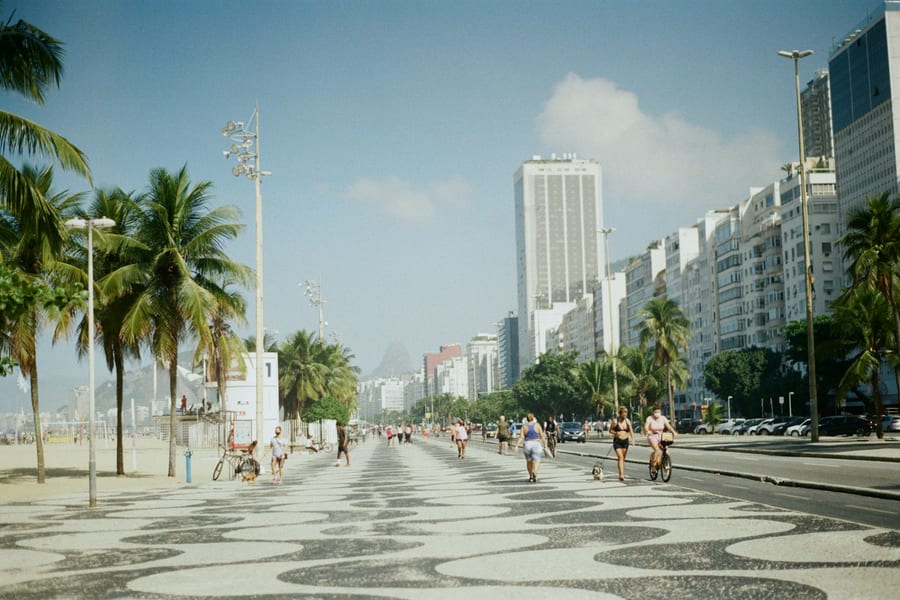
If Christ the Redeemer is Rio's soul, Pão de Açúcar (Sugarloaf Mountain) is its swagger, and the two together make one of the great city days on earth. Sugarloaf's cable car carries you in two stages over Guanabara Bay to a granite peak with a completely different perspective: instead of looking down on the bay, you're hovering above the water with the city draped around you.
My favourite rhythm: Christ the Redeemer early in the morning while the light is soft and the summit clear, then a leisurely lunch, then Sugarloaf in the late afternoon to catch the sunset turning the whole bay to copper. Two summits, two moods, one unforgettable day. We can build exactly this for you among our Rio day tours.

Practical logistics: getting there and what to bring
- Don't drive yourself to the top. Private cars can't reach the summit, you'll use the train or official vans for the final ascent regardless. Plan your route to the departure point (Cosme Velho for the train, or the designated van points), then let the official transport do the climbing.
- Bring layers. It can be 10°C cooler and noticeably windier at the summit than on the beach. A light jacket transforms the experience.
- Carry water and sun protection. The terraces are exposed; there's little shade.
- Go light. Large bags slow you through access points. Take a small daypack.
- Allow half a day. Between transport, queues, and time at the top, budget more than you think, and don't schedule anything tight immediately after.
- Pair it wisely. Christ the Redeemer fits beautifully into a longer Rio plan; if you're mapping a whole trip, our 2-week Brazil itinerary shows how the city slots together with the rest of the country.
Key takeaways
- Book a timed Christ the Redeemer ticket in advance, your ticket includes the official ride up, and slots sell out in high season.
- Choose your ascent: the historic cog railway (opened 1884) for romance, official vans for speed, or the Parque Lage hike for adventure.
- Go early on a clear morning, ideally in the drier winter months, to beat both crowds and cloud.
- The statue is a modern wonder, built 1922–1931, inaugurated 12 October 1931, and named one of the New 7 Wonders in 2007.
- Elevators and escalators serve the summit, but confirm accessibility per traveller, no blanket promises.
- Pair it with Sugarloaf at sunset for the ultimate Rio day.
Christ the Redeemer is not just a thing to tick off. It's a hundred-year-old act of devotion, a feat of engineering dressed in soft grey stone, a forest reborn by human hands, and a viewpoint that will reorder how you understand this beautiful, untidy, joyful city. Get your timing right, climb it with someone who knows its stories, and it becomes the moment your whole Brazil trip pivots around. When you're ready, we'll handle the details, see our full range of Rio destinations, or just say hello.
Ready to stand at the feet of the Redeemer with the city at yours? Let's plan your Rio, tickets, timing, and all the secret bits.
Plan my trip on WhatsAppImage credits: Rjcastillo / CC BY 4.0, via Wikimedia Commons; Donatas Dabravolskas / CC BY-SA 4.0, via Wikimedia Commons; MKP27091961 / CC BY-SA 3.0, via Wikimedia Commons. Other photos via Unsplash or in the public domain.